
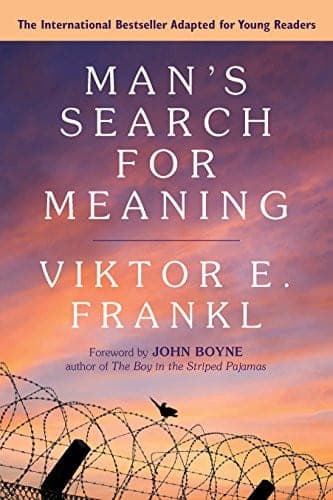
Man's Search for Meaning – Viktor Frankl
Everyone calls this a must read. It isn't.
Two very different things sit between these covers. One deserves respect. The other is what the reputation is built on, and it doesn't hold up.
What the Book Actually Is
Frankl was a Viennese psychiatrist. Held in four Nazi camps, Auschwitz among them. Lost his wife, his parents and his brother. Came out and dictated the first part of this book in nine days.
Two halves:
- Experiences in a Concentration Camp – what he saw, and who survived.
- Logotherapy in a Nutshell – the therapy he built out of it.
The testimony is one thing. The promise on the cover is another. They need separating.
The Testimony
The camp section is the account of a man who survived four camps and lost nearly everyone he loved.
The selection at the gate, a finger pointing left or right. Prisoners giving away their last bread. Men dying within days of losing their reason to see next week. Frankl records it plainly and it needs no amplification. A first-hand record of the Holocaust, written by someone who lived inside it.
That weight is real. Read it for that and your time is well spent.
But that isn't why the book gets pressed into your hands. It gets sold as a manual for living. Judged on that, the picture changes.
The One Idea
Everything rests on a single reversal.
Stop asking what you want from your circumstances. Ask what your circumstances are asking of you. You don't choose the conditions. You choose the response.
Good idea. In 1946 it was new.
It's 2026. You've met this idea a hundred times. Decades of leadership writing, self-help and repackaged stoicism carried it into every corner of working life, mostly without crediting where it came from. By the time you open Frankl, the one thing he has to give you is already yours.
The Theory Half
Part two falls over completely.
Logotherapy gets explained, explained again, then defended against Freud and Adler across several pages. Arguments from a psychiatric debate that ended generations ago. Patient cases arrive in three sentences with a cure stapled on the end. A man walks in carrying decades of grief, Frankl asks one question, the man walks out at peace.
Nobody who has managed people, or lived a life, believes change works like that.
A period piece. Archival interest. No practical use. And it's nearly half the book.
The Misuse
Frankl wrote about finding meaning inside conditions nobody chose and nobody designed. The idea now gets applied to conditions people designed themselves. Understaffed team. Unclear priorities. A broken process nobody will fix. Then this book gets handed out and the word resilience gets used.
That's not resilience. That's a leader outsourcing their own job.
The conditions Frankl endured were built by his captors. The conditions your team endures are built by you.
Flattening Auschwitz into a management slogan does the man no honour. It uses him.
What Stuck With Me
The line Frankl borrows from Nietzsche:
"He who has a why to live for can bear almost any how."
A good line. Also the most quotable thing in the book, and not his.
Final Verdict
Not a must read.
Read it as testimony and you'll get something real. That's the honest reason to pick it up.
As the life-changing book it's sold as, skip it. The idea reached you decades ago through everything written since. The theory belongs in a museum. The reputation belongs to what this book was in 1946, not what it is on your shelf today.
Some books earn a place on every list. This one earns a place in history. Two different things.