
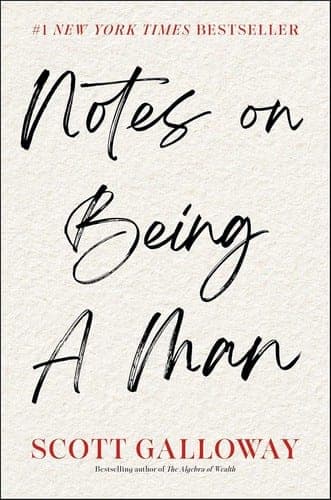
Galloway at his most personal. Sharp in parts, uneven in others, but it made me think about the example I set.
What I took from it
- Protect, provide, procreate, but make it present. The old frame kept sending me back to my father, and to the father I want to be.
- Action absorbs anxiety. When I'm actually in the room, the fear of not being enough quietens.
- It is less about what you achieve and more about how you make people feel.
I bought this book because I'm in a weird season. Asking bigger questions. Not "how do I hit this target?" More like, what kind of man am I becoming, and will my kids be proud of that man?
The back cover calls it "an enriching and inspiring operator's manual for being a man today." Galloway's a professor, entrepreneur, podcaster. And by his own messy admission, a guy who spent decades chasing money and status to fill a hole left by an absent father. That honesty pulls you in. Also made me cringe. You see yourself in some of it.
My father was present. Police officer in the SAPS. Served over 40 years. Retired as a general, the highest rank he could achieve, the ceiling for his path. This was 1994. New South Africa, after the elections. White Afrikaans man in a transformed system, working his way up through merit and endurance. He protected and provided. That was his calling. His presence was structural, not theatrical. Built the floor we stood on. I didn't always have the language for it as a kid. I do now.
He went on pension when I was out of school. I saw the arc. Decades of service. Rank earned. Retirement that came after the work was done. Shaped how I understood provision. Wasn't immediate. Built over time.
I became a father and fell into a rhythm that looked like his from the outside. Working. Providing. Protecting. Told myself I was honouring his example. But I was using the parts that suited me and ignoring the part where he was actually there when it mattered. Hiding behind a half-truth. Not always at rugby, hockey or school events. Got home late, kids already in bed. Weekends in front of my laptop. Told myself this was what fatherhood looked like. It wasn't. It was what avoidance looked like.
Here's where my story diverges from Galloway's. I'm a father of four. Two biological. Two not. Stepped in when they were four and one. Their father was absent. I didn't have to. I chose to. Don't want to sound like a hero. Didn't save anyone. Just stayed. And staying is harder than it sounds, especially when you're not sure you're actually there even when you're in the room.
Actively working on being present now. Not perfectly. No system. Just trying to be in the room, the conversation, the moment. Harder than providing. Harder than protecting. But it's the thing my kids need most.
Galloway writes from the wound of absence. I write from the choice of presence, inherited from a man who showed me protection and provision are languages of love, even when they don't look like the Instagram version of fatherhood. Trying to add a third language. Showing up. Being there. Actually there.
That difference changes how this book lands.
What I'm Sitting With
Galloway frames masculinity around three things. Protect, provide, procreate. Sounds old-school, maybe reductive. But I kept thinking about my father in the days after.
Protect. My father did this literally. Uniform, badge, 40 years of service. But it's also the willingness to step into the uncomfortable thing so someone else doesn't carry it alone. I've tried to do that in my own way. Not because I'm brave. Because I know what it feels like to be left alone with something hard. That instinct shows up everywhere now. At home, in friendships, in rooms where I lead. Same muscle, different weight.
Provide. My father provided structurally. Stability, foundation, security from decades of showing up. I grew up knowing the roof was solid, future handled, plan built over time. Form of love I didn't appreciate until I had to do it myself. Trying to do the same. Also learning provision isn't just financial. Sometimes it's time. Sometimes clarity. Sometimes being fully in the room, attention on, not mentally three meetings ahead. Not good at that last part. Trying.
Procreate. Galloway means biological legacy. I'm applying it differently. Two of my kids don't share my DNA. Doesn't make me less their father. Makes me question what legacy actually means. Is it blood? Or showing up every day when you didn't have to? If I left tomorrow, would they still call me Dad? Would they still feel chosen? Real question. Nothing to do with biology.
Action absorbs anxiety.
One of the back cover pull quotes. Simple. True. Something I need tattooed on my forehead.
Galloway talks about missing his kids' early years because he was "building." On calls during dinner, mentally elsewhere at bedtime, always chasing the next thing. Quotes Sam Harris:
Your real purpose is just to love them.
Felt that in my chest. Been the guy checking my phone in conversations or at functions. The guy who says "just one more thing" and then it's dark outside. But here's what haunts me more. Stepped into my two older kids' lives when they were four and one. Didn't get the early years. Their biological father did. Then he left. I got what was left. And still wasted some of it on my phone. On my ego. On "building."
Not proud of it. Book didn't give me a system to fix it. Galloway isn't great on practical habits. But gave me the language to name what I was doing. Step one, I guess. And the "action absorbs anxiety" line helps. When I'm present, actually present, the anxiety of not being enough fades. It's the doing that matters. Not the planning. Not the thinking. The being there.
"How do you make people feel?"
The line I keep coming back to. Galloway asks:
Do they feel insecure or inspired? Cold or comforted? Do you bring joy, harmony, love?
Made it my phone background. Not because I'm naturally good at it. Because I'm not. Direct, sometimes sharp, often more focused on the outcome than the person in front of me. People tell me I'm intimidating, which surprises me because inside I feel like I'm barely holding it together. But perception is reality. If people feel smaller after interacting with me, that's on me, not them.
At home, it's even harder. My two older kids came from a situation where they were left. Didn't choose me. I chose them. Means the bar is higher. Don't get to have a bad day and snap and expect them to absorb it. They already absorbed that from someone else. I have to be the floor, not the ceiling. The constant, not the variable.
Not always good at it. But I'm trying.
Be of surplus value. Be kind.
Two more back cover lines. "Acknowledge your blessings, and create opportunities for others." "Be of surplus value." "Be kind."
Sound like motivational poster fluff. But Galloway grounds them in something real. Idea that masculinity isn't about taking up space. It's about adding value. Being the person who makes things better just by being there. Leaves a room warmer than they found it.
Not that guy naturally. I'm the guy who enters a room and assesses. Fixes. Solves. Sometimes that's needed. Sometimes it's just taking up space with my own urgency. Trying to learn the difference.
Where I Argued With the Page
The science is thin.
Galloway calls testosterone the "holy molecule" and talks about it like destiny in a bottle. Barely cites research. Grated on me. Can't just say "testosterone makes men protective" and not show your working. Actual science on hormones and behaviour is nuanced, contested, way more interesting than he lets on. Felt like he found a narrative that fit his story and stopped digging.
The father absence argument. I live it, but it's still incomplete.
Galloway writes that "most boys come apart when a male role model leaves." My father was present. Didn't experience that specific wound.
But I see it every day. In my two older kids. In the way they flinch sometimes when a man raises his voice. In the way they test me, constantly, to see if I'll leave too. In the questions they don't ask but I know they're thinking.
Galloway doesn't engage with the complexity though. What about fathers who are present but destructive? What about economic and social factors that often accompany absence? Takes a real phenomenon and stretches it toward a universal rule, when it's really just his rule.
I see the truth in it. I live the truth in it. But also know presence without intention is just geography. Being in the room isn't enough. You have to be in the room. My father taught me that. Not with words. With 40 years of service.
The capitalism is unexamined.
Galloway made his money in tech and media. Advocates hard work, risk-taking, "failing fast." All fine. But says every young man should work a service job to gain empathy, then immediately pivots back to hustle culture. Never really asks: what if the system itself is making men feel lost?
What if the masculinity crisis and the burnout crisis are the same thing? What if telling men to "protect" their families while glorifying 80-hour weeks is the contradiction that breaks them? My father worked long hours, especially as he rose through the ranks. But that was service. That was the calling. Don't think Galloway has language for that kind of work. The kind that isn't about status or accumulation. The kind that is service.
Trying to build something sustainable. For my family. For myself. Galloway doesn't have much to say about that. Just has more hustle.
The gender essentialism.
He rejects "toxic masculinity" as an oxymoron, which I actually agree with. Cruelty isn't masculine, it's just cruelty. But then he defines masculinity so narrowly that he excludes half the men I know. Men who don't want kids. Men who express emotion differently. Men who aren't physically imposing.
And here's where it gets personal for me. Writes like fatherhood is biological destiny. Like the only real father is the one who provided the DNA. Didn't provide DNA for two of my kids. I provide something else. Consistency. The choice to stay when I could have walked away. Daily proof that love is an action, not a bloodline.
Galloway doesn't have language for that. Blind spot.
What I'm Actually Trying to Do Differently
Book didn't give me a checklist. But surfaced some questions I'm trying to live into. And some things I'm not doing yet, but probably should be.
At home. Actively working on being present. No gimmicks. No rules. Just trying to be in the room, the conversation, the moment. When my kids are talking, trying to hear them. Not plan my response. Not think about what I need to do later. Just listen. Not good at it. Better than I was. That's something.
With my two older kids, it's different. They need more. Reassurance that I'm not going anywhere. That I chose them. That I choose them every day. I tell them that. I show them that. Not perfect at it. But consistent.
With myself. Spent the last six odd months working on myself. Not because the book told me to. Because I realised I was carrying more than I was admitting, and the people around me were paying for it. Uncomfortable. Necessary. Not fixed. Not done. But facing things I used to bury under work and distraction.
Stepping into fatherhood for kids who had been left means I carry their wound too. The anger they don't know how to express. The questions they don't ask. The weight of knowing that if I leave, it confirms something they already believe about men. Heavy thing. Working on myself helps me carry it without breaking.
On health. Galloway talks about physical fitness as a masculine virtue. Exercise, strength, taking care of your body. I'm far from that. Not the guy who wakes up at 5am to run. Not the guy who counts macros. Know I should be more active. Know my kids need me around for the long haul. But not there yet. On the list. Not crossed off. Maybe that's the next thing to face.
The Chapter That Broke Me
Last section is about mortality. Galloway writes about wanting to die at home, surrounded by people who love him, not in a hospital under bright lights with strangers. Asks: "How do you make people feel?"
Thought about my funeral. Not morbid. Clarifying. Who would be there? What would they say?
Four kids. Two with my eyes. Two with someone else's. But all four calling me Dad. That's the legacy I want. Not the biological one. The chosen one.
Would they talk about my achievements, or about how I made them feel? Would they remember the times I was present, or the times I was distracted? Would my two older kids remember that I stayed when I didn't have to?
Don't have good answers yet. But I'm asking the questions now, which is more than I was doing six months ago.
Final Verdict
This book is imperfect. Repetitive, thin on research, and Galloway's privilege shows in ways he doesn't fully see. But I underlined more than I expected. Argued with it more than most books. And I've caught myself thinking about the "Three P's" at odd moments. In a difficult conversation. At the school gate. On a late-night drive home.
Best books don't give you answers. They give you language for the questions you were already avoiding.
Would I recommend it? Yes, with a filter. Read it for the vulnerability and the practical nuggets. Argue with the rest. Best books don't just confirm what you think. They make you work for what you believe.
It would have landed higher with better citations, less gender essentialism, and some recognition that fatherhood is a choice, not just biology. Still going on my shelf. Still thinking about it.