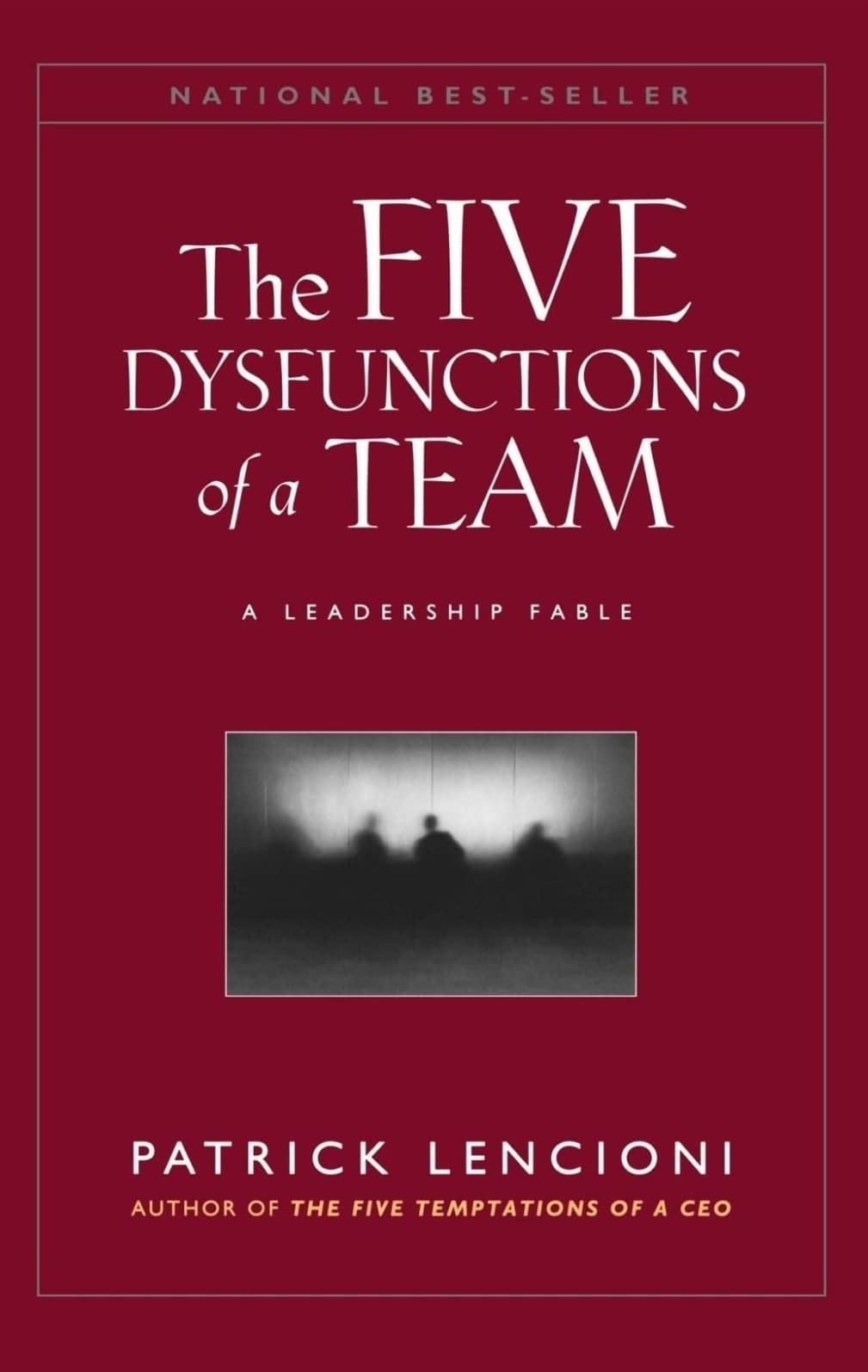
The Five Dysfunctions of a Team – Patrick Lencioni
George Mienie, CEO of AutoTrader, handed me this book before I even started. Part of onboarding. Not a suggestion. Something he believed mattered. I've read it multiple times since. One of the few business books that earned its shelf space through actual use, not reputation alone.
Lencioni's model is simple. Five dysfunctions stacked like a pyramid. Trust at the bottom, results at the top. Crack the foundation and everything above wobbles. Sounds obvious when you read it. Not so obvious when you're building culture from scratch.
At AutoTrader, this framework wasn't just read. It was instilled. Driven consistently. And that shaped a culture that was genuinely great to be part of.
The Five Dysfunctions, Briefly
Lencioni's five:
- Absence of Trust – unwilling to be vulnerable, admit mistakes, ask for help.
- Fear of Conflict – no productive debate without trust. Retreat into guarded comments and fake harmony.
- Lack of Commitment – without real debate, people don't buy in. They nod and quietly doubt.
- Avoidance of Accountability – without commitment, nobody calls out counterproductive behaviour in peers.
- Inattention to Results – individual status and ego take priority over collective goals.
The book is a fable. Kathryn Petersen becomes CEO of DecisionTech, a fictional tech company with a mess of an executive team. She fixes it using the model. Fast read. The fable format makes concepts stick. But the real value isn't the story. It's recognising what a healthy team looks like, and having language to protect it.
What I Saw at AutoTrader
Won't name names or departments. Not the point. But I'll be specific about dynamics, because generic praise is useless. Lencioni's model works because it's specific. So this review needs to be too.
Trust was the foundation.
At AutoTrader, trust wasn't some abstract value on a poster. It was practised. People admitted when they didn't know something. Asked for help. Said "I got this wrong," and the room didn't use it against them. That's rare. I've worked places where vulnerability was currency you spent at your own risk. At AutoTrader, it bought you better decisions and stronger relationships.
George Mienie modelled this from the top. Direct, sometimes sharp. Set the tone. When the CEO leads with honesty, everyone else gets permission to do the same. That permission is what makes trust possible.
Conflict was productive, not personal.
This changed me most. One of my weaknesses: the need to be liked. I avoided conflict. Smoothed things over. Told myself I was keeping the peace, but really I was avoiding the discomfort of disagreement. George saw this. Didn't ignore it. Purposely placed me in positions where I had to engage in positive conflict. Argue for a position. Challenge an idea. Sit in the tension without rushing to resolution.
Uncomfortable. Necessary. Made me better.
That's what Lencioni means by healthy conflict. Not shouting. Not aggression. The willingness to say "I think this is wrong" and trust the other person is arguing with the idea, not with you. AutoTrader had that. Not perfectly every time. But as a consistent pattern. Made decisions better.
I remember a meeting where three different approaches got argued for, hard, right there in the room. No one took it personally. Decision made. Everyone committed. Moved on. That's what productive conflict looks like. Not political.
What struck me most: how allergic the culture was to office politics. And not just a few people. A large percentage of the business. We called it out. Directly. Someone manoeuvring, playing angles, building alliances instead of arguing the idea on its merits, someone would say so. Not aggressively. Just clearly. "That feels political. Let's get back to the work." That kind of cultural immunity doesn't happen by accident. It's built, maintained, protected. AutoTrader protected it.
Commitment followed naturally.
Because the debate was real, commitment was real too. People didn't nod in the room then execute at 70 percent. They bought in. Even when their particular idea didn't win. Because their perspective had been heard. That's the difference Lencioni points out. Commitment isn't consensus. It's clarity plus respect. AutoTrader got that right.
Accountability was mutual.
This one takes longest to build. Peers holding peers accountable. Not because the manager said so. Because the standard was shared. I saw this at AutoTrader. Someone misses a deadline. Not catastrophically. Just enough to shift work onto others. And someone says something. Not sharply. Not publicly. But directly. "This impacted me. Let's figure out how to fix it."
Hard to do. Requires trust. Requires believing the person receiving feedback knows it's about the work, not about them. AutoTrader had built enough trust that this was possible. Not always comfortable. But possible. Made the team better.
Results were the only thing that mattered.
Final piece. When trust, conflict, commitment, and accountability are in place, results become the natural focus. Not because you force them. Because there's no energy left for politics. No one hoarding Slack messages or honing stories about why something wasn't their fault. Everyone focused on the collective outcome.
At AutoTrader, every department had KPIs. But they were tied to the overall target. Sales, product, marketing, operations. Everyone knew how their number fed the bigger number. And when the company hit target, it was celebrated as a team. Not as individual achievements. That's what inattention to results looks like in reverse. Attention to results, collectively.
What Stuck With Me
The book isn't perfect. Fable format is effective but can feel thin if you want deep organisational theory. Lencioni doesn't engage with power dynamics, diversity, or structural realities of modern workplaces. The model's also quite individualistic. Assumes fixing team dynamics means results follow. Not always true. Sometimes the market's wrong. Sometimes the strategy's wrong. Sometimes the team's fine and the problem's upstream.
But the model is a mirror. And at AutoTrader, I saw what it looks like when the reflection is good. A team actually functioning the way Lencioni describes. Gave me language for things I was experiencing but couldn't name. Made me a better leader because it made me a more honest observer.
The line I keep coming back to:
"Remember, teamwork begins by building trust. And the only way to do that is to overcome our need for invulnerability."
That's the work. Not a workshop. Not a trust fall exercise. The daily, unglamorous choice to be honest about what you don't know, invite disagreement, commit to decisions you're not sure about, hold your peers to a standard, and care more about the result than your own credit.
Saw it done well at AutoTrader. Still working on doing it well myself.
Final Verdict
Recommend this book? Absolutely. Not just to read. To use. Hand to someone before they join your team, the way George Mienie handed it to me. Revisit when you feel a team sliding. Argue with when you think it's too simple.
For me, the value wasn't just the fable or theory. It was the recognition. Seeing a real team at AutoTrader live inside Lencioni's pyramid and make it work. Understanding that good people, smart people, well-intentioned people, can build something genuinely functional when they have the right framework and discipline to stick to it.
On my shelf. Lent it out more than once. Quick read that punches above its weight. If you lead a team, or are part of one that wants to be better, worth the afternoon it takes.
Not because it will solve your problems. Because it will help you see what's possible when you build the foundation right.